

The agreement that governs Panama’s trade with the United States
The Trade Promotion Agreement (TPA) between Panama and the United States is the framework that governs trade between the two countries today. Here we summarize what it establishes and where to consult the official text.
- October 21, 2011
Signed into law
The United States Congress approves the Trade Promotion Agreement with Panama.
- October 31, 2012
Enters into force
The agreement takes effect in both countries, and with it the bilateral free trade area.
The scope of the agreement
The TPA established a permanent framework for trade relations between Panama and the United States, strengthening the conditions to promote exports and encourage foreign investment in the country.
Free Trade
A bilateral free trade area that eliminates tariffs on the vast majority of products meeting the agreement’s rules of origin.
Bilateral Trade Facilitation
Includes specific provisions on customs administration and trade facilitation, aimed at speeding up and streamlining the exchange of goods.
Trade in Services
Liberalizes cross-border trade in services across a wide range of sectors, with specific provisions for financial services and telecommunications.
Regulatory framework
Strengthens the rules applicable to investment, intellectual property, labor rights, environmental protection and public procurement, taking as reference the commitments and principles established under the WTO.
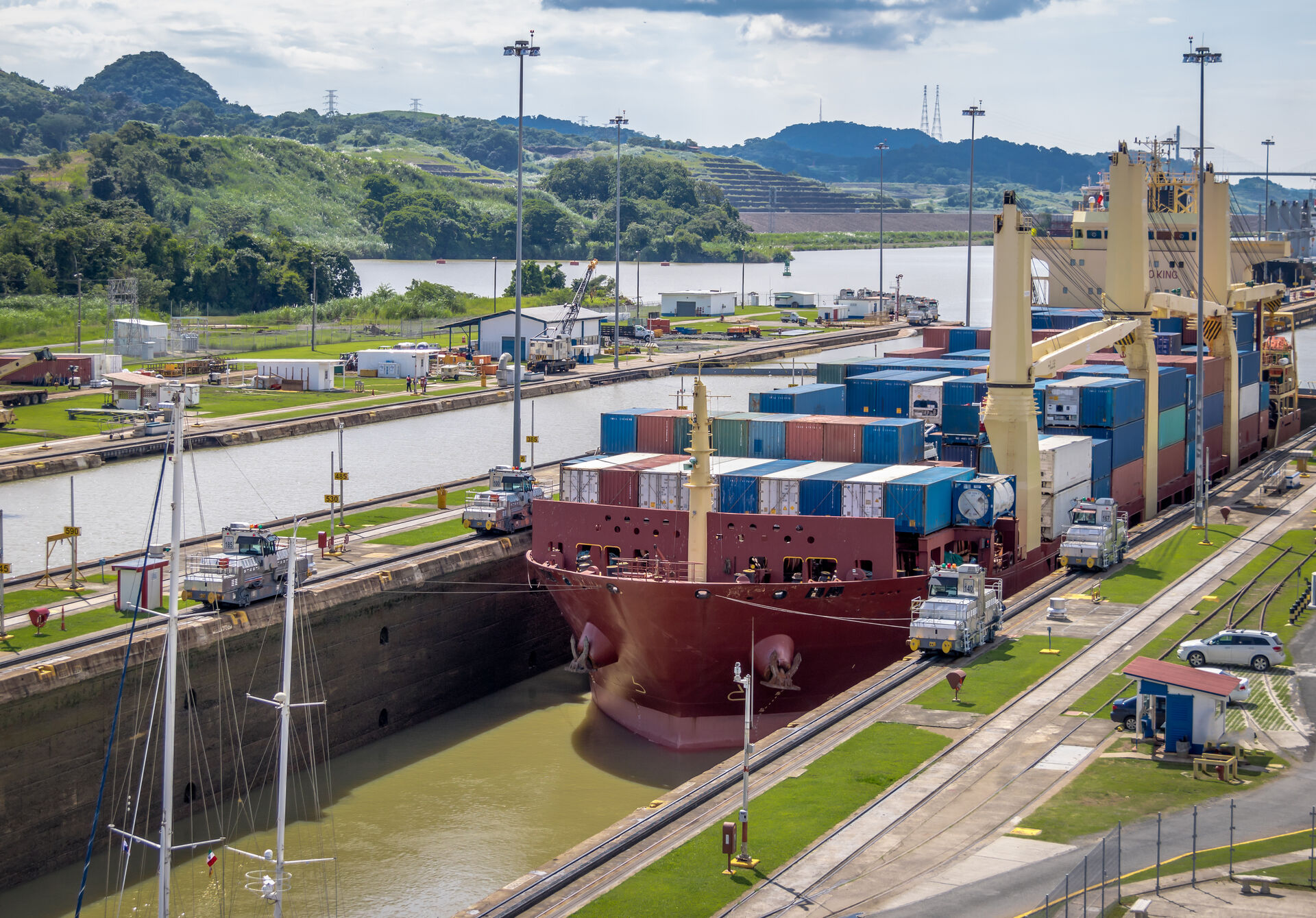
Bilateral trade flows in recent years
Between 2021 and 2025, Panama purchased US$50,130.4 million in U.S. goods and sold US$3,014.8 million to the United States, according to the U.S. Census Bureau. The cumulative U.S. surplus was US$47,115.6 million: for every dollar Panama exported, it bought close to seventeen.
The trajectory has not been linear. U.S. exports grew 45.5% in 2022 and have declined every year since, ending just 10.9% above the 2021 level. Imports from Panama did the opposite: they fell 30.8% in 2022 and have recovered steadily. The surplus peaked that year at US$11,177.9 million.
2025 figures
- U.S. exports to PanamaUS$8,914.2 M−16.5% versus 2024
- U.S. imports from PanamaUS$659.5 M+19.3% versus 2024
- U.S. trade surplusUS$8,254.7 M−18.4% versus 2024
- Total goods tradeUS$9,573.7 M−14.7% versus 2024
Goods exports and imports, 2021–2025
US$ millions
- U.S. exports to Panama
- U.S. imports from Panama
| Year | U.S. exports to Panama | U.S. imports from Panama |
|---|---|---|
| 2021 | 8,039.5 | 755.4 |
| 2022 | 11,700.7 | 522.8 |
| 2023 | 10,801.6 | 524.3 |
| 2024 | 10,674.4 | 552.8 |
| 2025 | 8,914.2 | 659.5 |
U.S. trade surplus
Exports minus imports · US$ millions
Peak in 2022 · −18.4% in 2025 versus 2024
| Year | U.S. trade surplus |
|---|---|
| 2021 | 7,284.1 |
| 2022 | 11,177.9 |
| 2023 | 10,277.3 |
| 2024 | 10,121.6 |
| 2025 | 8,254.7 |
Year-over-year change
Change from the previous year, in %
- U.S. exports
- U.S. imports
| Year | U.S. exports | U.S. imports |
|---|---|---|
| 2022 | +45.5% | −30.8% |
| 2023 | −7.7% | +0.3% |
| 2024 | −1.2% | +5.4% |
| 2025 | −16.5% | +19.3% |
Between 2021 and 2025, Panama’s recorded exports to the United States held between US$127 and US$172 million a year. They dipped slightly in 2022, grew 17.5% in 2023 and 15.3% in 2024, when they reached their peak for the period at US$172.3 million, and in 2025 fell back 15.1% to US$146.2 million. The United States remains a stable destination for Panamanian exports.
Panama’s recorded exports to the U.S., 2021–2026
US$ millions, FOB, excluding copper
| Year | Panama’s recorded exports |
|---|---|
| 2021 | 133.5 |
| 2022 | 127.2 |
| 2023 | 149.5 |
| 2024 | 172.3 |
| 2025 | 146.2 |
| 2026 (partial) | 124.6 |
Source: Panama’s recorded exports (FOB, excluding copper). *2026: current year, partial figure.
The export basket is concentrated in products from the sea and the countryside. From 2021 to 2026, fishing accounted for 40% of exports to the United States, agriculture for 28% and agribusiness for 22%; together, nine out of every ten dollars. Industry contributed the remaining 10%.
Panama’s exports to the U.S. by sector
2021–2026 cumulative · US$ millions, FOB
- PescaUS$342.6 M40.1%
- AgrícolaUS$240.0 M28.1%
- AgroindustriaUS$186.5 M21.9%
- IndustriaUS$84.3 M9.9%
| Sector | US$ millions | Share |
|---|---|---|
| Pesca | 342.6 | 40.1% |
| Agrícola | 240.0 | 28.1% |
| Agroindustria | 186.5 | 21.9% |
| Industria | 84.3 | 9.9% |
Source: Panama’s recorded exports (FOB, excluding copper), 2021–2026 cumulative.
What you should know about the TPA
What is the TPA?
A Trade Promotion Agreement between Panama and the United States that established a bilateral free trade area and set permanent rules for trade between the two countries.
Since when has it been in force?
It was signed into law on October 21, 2011 and entered into force in both countries on October 31, 2012.
What happens with tariffs?
They are eliminated on the vast majority of products that meet the agreement’s rules of origin. There are also provisions on customs administration and trade facilitation.
What benefit does it bring to Panamanian companies exporting to the United States?
Most Panamanian products already enter the United States free of tariffs and of the merchandise processing fee (MPF). The rest are phased out progressively until the agreement is fully implemented in 2028.
What are the rules of origin and why do they matter?
They determine whether a product qualifies for preferential tariff treatment under the TPA. To claim the benefit, a company must support its request with a Certificate of Origin attesting to the originating status of the goods.
How does a Panamanian company access preferential treatment under the TPA?
It must meet the agreement’s rules of origin and present the corresponding Certificate of Origin to U.S. customs at the time of import. AmCham’s Trade Center can guide your company through this process.
Does it only cover goods?
No. It liberalizes cross-border trade in practically all services, with dedicated chapters on financial services and telecommunications, and strengthens the rules on investment, intellectual property, labor, the environment and public procurement.
What guarantees does it offer investors?
It establishes fair treatment standards for investors and a neutral, transparent mechanism for resolving investment-related disputes, with access to international arbitration.
Does the TPA cover government procurement?
Yes. It establishes clear rules and procedures so that companies can take part in open government procurement processes, in both Panama and the United States.
What commitments does it include on labor and transparency?
Both countries commit to protecting and respecting workers’ basic rights, and to promoting transparency and fighting corruption in international trade and investment.
Relevant institutions and regimes
- Office of the United States Trade Representative (opens in a new tab)
- USDA Panama GSM 102 and Facility Guarantee Program (opens in a new tab)
- Ministry of Commerce and Industry (opens in a new tab)
- Office for Investment Attraction and Export Promotion — MICI (opens in a new tab)
- Panamá Pacífico (opens in a new tab)
- Ciudad del Saber (opens in a new tab)
- Colón Free Zone (opens in a new tab)
- Multinational Company Headquarters (SEM) (opens in a new tab)
- Panama Film Commission (opens in a new tab)
- Barú Free Zone (opens in a new tab)
- Panama Tourism Authority (opens in a new tab)
- Panama Canal Authority (opens in a new tab)
- Panama Country Brand (opens in a new tab)
- Panama’s AI Strategy (opens in a new tab)
- Panama Smart — Semiconductors and Microelectronics (opens in a new tab)
- National Secretariat for Science, Technology and Innovation (opens in a new tab)
Need the official text of the TPA?
The final text of the agreement, along with the corresponding explanatory document, is published by the Ministry of Commerce and Industry (MICI).